You have already asked for a flight-ticket refund. The useful next step is to establish what has happened to that request, who is handling it and what evidence you should keep. A cancellation acknowledgement, a refund calculation and money appearing in your account answer different questions.
This guide is for following an existing request. If you have not decided whether to cancel, start with our before-cancellation checklist. If you still intend to travel on different dates, use the flight date-change guide instead. Do not submit another cancellation just to ask about a refund.
Find the original seller and existing request
Start with the receipt, ticket confirmation and the channel through which you made the request. Keep the existing case reference together with the booking details. Ask the original seller which team is handling the refund and whether you should continue in that same conversation.
For example, Air India’s refund guidance directs customers who bought through a travel agent or another portal to that seller. Lufthansa’s guidance also directs agency and third-party bookings back to the booking provider. These are carrier examples, not proof that every refund uses the same process.
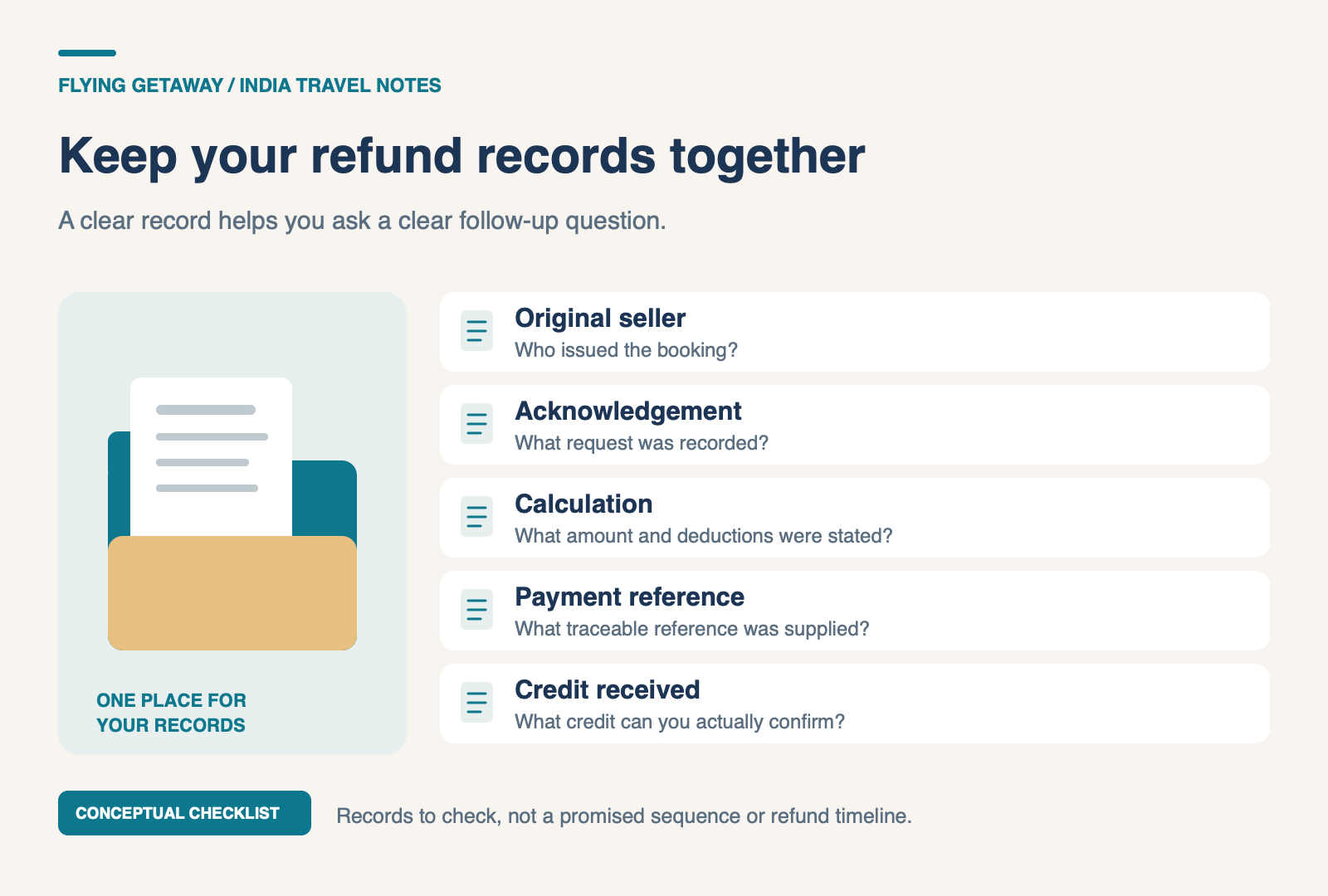
Keep a small, organised record
- The original booking confirmation and receipt, kept privately.
- The cancellation or refund-request acknowledgement, its date and case reference.
- Which travellers, flights and extras the request covers.
- The written refund calculation, including currency and any stated deductions.
- The latest response and the next action or update date actually given by the handler.
- Any payment reference supplied for tracing a refund, plus your own confirmation when the credit arrives.
A single dated record helps you explain the gap without sending the same attachments repeatedly. Preserve the original messages. If you make a short summary, distinguish what the handler confirmed from what you are still asking them to check.
Ask what the status actually means
Do not assume every airline or agency uses the same status labels. The following are questions to clarify, not stages in a universal tracking system. Use the wording in your actual response and ask what evidence supports it.
- Request received: has the handler only acknowledged your message, or accepted a refund request for the specified ticket?
- Amount approved: is there a written calculation, and which flights, passengers or extras does it cover?
- Payment sent: has money actually been released, by whom, to which original payment route, and is a traceable reference available?
- Credit received: can you identify the matching credit in your own payment account, rather than only an email saying the refund is complete?
If an agency says the airline has refunded it, ask what remains before the agency’s payment to you. If the response says “processed”, ask whether that means approval, payment release or something else. Do not infer that a payment has reached you from an ambiguous status alone.
Reconcile the amount and payment route
Ask for the calculation in writing if the amount is unclear. Identify the currency, affected ticket portions, extras included or excluded, and any separately stated charge. Compare that explanation with the confirmation already supplied rather than assuming the refund must equal the original purchase total.
Lufthansa’s published guidance ties refunds to fare conditions and ticket use and describes repayment to the original payment method. That illustrates why the actual booking terms and payment route matter. It is not a promise about the amount or timing of your own request.
If the handler confirms payment was sent but you cannot find it, ask for the relevant payment date and tracing reference, if available. Use your bank or payment provider’s official support route to ask what information it needs. Share only the details necessary for that enquiry through a verified channel.
Follow up with one clear question
A concise follow-up can state when you requested the refund, identify the existing case, repeat the latest confirmed status and ask what remains unresolved. For example: “Please confirm whether this request is awaiting a calculation or whether payment has been released. If released, please provide the payment date and available tracing reference through this existing support channel.”
Use the update date the handler actually gave you. If it passes without an answer, refer to that message and ask for a revised update and the appropriate official support route. This guide does not set a refund deadline, guarantee a payment or describe a statutory entitlement.
Keep credentials out of the conversation
Never send card security codes, full payment-card numbers, bank passwords or OTPs in a refund follow-up. Do not post booking references or payment records in public comments. If evidence is needed, ask which specific fields are required and redact unrelated transactions, balances and personal details. A screenshot of an entire account is not the starting point.
For a Flying Getaway booking, contact the team about your existing request. For a booking made elsewhere, begin with that seller. Flying Getaway is an independent travel agency; this checklist does not imply access to another seller’s refund system.
Sources and review scope
Official pages checked on 14 November 2026. This article helps organise an existing request; it does not initiate a cancellation, calculate an entitlement or promise a processing time.
Air India refund guidance: original booking-channel direction only. Numerical charges, historical regulatory references and time limits are not reproduced.
Lufthansa cancellation and refund guidance: booking-provider direction, fare-condition and ticket-use qualifications, and original payment route. No blanket full-refund claim is inferred.